
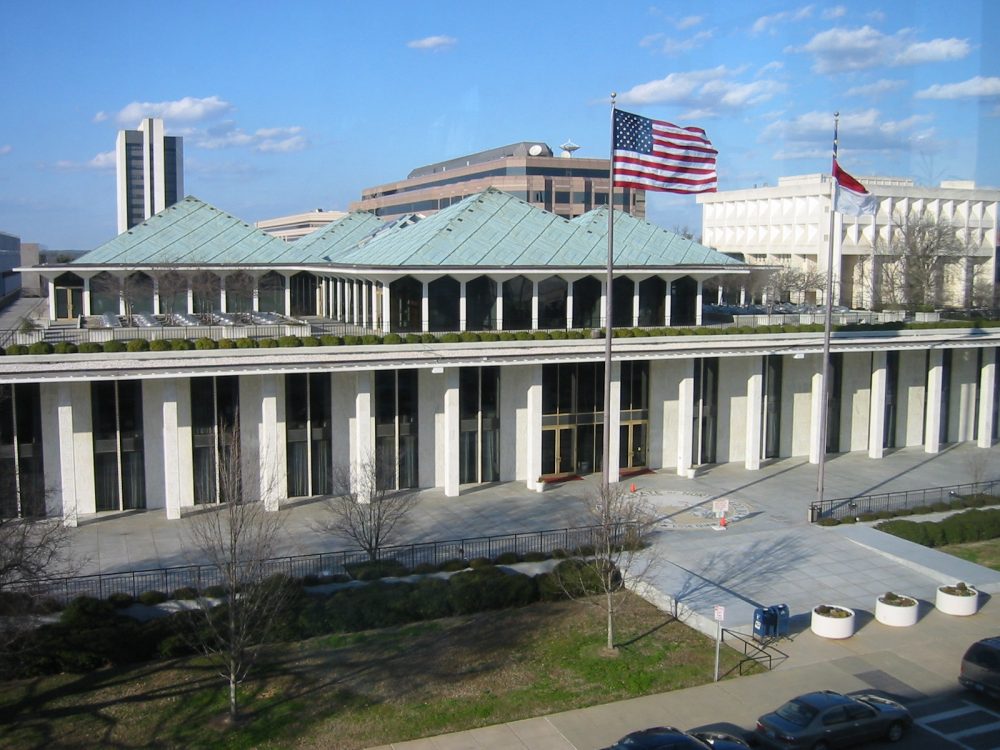
Legislative advocacy is a vital part of the Council’s work because we recognize that much of our state’s legislation has been shaped by a legacy of racism. Guided by the principles of advocating with compassion, we center the voices of marginalized communities and engage with decision-makers with empathy, respect, and care. Through this approach, we work to advance just and compassionate policies in North Carolina that help all people flourish, regardless of race or ethnicity.
Advocating with compassion means approaching public engagement with empathy, respect, and relationship‑building at the center of your work. It means listening to others’ stories and what they love before discussing the issues you care about, seeking to understand different beliefs and values, and honoring the humanity of both the people you’re advocating for and those you’re engaging with. Compassionate advocacy includes everyone—there’s no “us vs. them”—and remains grounded in love and justice, even when conversations are challenging. It also recognizes the importance of caring for yourself in the process so you can sustain long‑term involvement
Issue Statements
- Resolution on Reproductive Health (September 13, 2022)
- A Resolution to Change the Cash Bail Bond System (August 8, 2022)
- Statement Condemning Violence Against our Jewish Neighbors (January 24, 2022)
- Statement on George Floyd Murder Trial Verdict (April 21, 2021)
- Remove Confederate Symbols Where Justice Is Sought (January 26, 2021)
- Statement on Systemic Racism (June 2, 2020)
- Reaffirmation of Support for the LGBTQ+ Community (June 10, 2019)
- Statement of Opposition to Constitutional Amendments (September 18, 2018)
- Statement Affirming the Ministry of Sanctuary by Congregations (March 8, 2018)
- Policy Statement on the Public Schools (December 15, 2017)
- Confederate-themed monuments: Time to reassess (September 21, 2017)
- Statement Supporting Transparency and Accountability on American Involvement in Torture (September 13, 2017)
- Statement Opposing Fracked Gas Pipelines (September 12, 2017)
- Statement Opposing Offshore Drilling (March 1, 2016)
- Guaranteeing Suffrage, the Right to Vote (December 13, 2013)
- NCCC Board Statement on Syria (September 10, 2013)
- Affirming Principles of Concern for the Poor and Vulnerable (June 8, 2012)
- On the Importance of the State’s Public Health System (June 7, 2012)
- Statement on Accusations about Candidates’ Faith (March 15, 2012)
- Rural Life Committee Supports Ban on Fracking (August 18, 2011)
- Statement on Annual Utility Rate Hikes without NC Utility Commission Review (March 1, 2011)
- Statement on Physical Activity and Nutrition (December 6, 2010)
- Statement on the New York Muslim Community Center Controversy (September 21, 2010)
- Ownership of Agricultural Seeds (March 20, 2010)
- A Policy Statement on Mountaintop Removal Coal Mining (December 1, 2009)
- Statement on Local Immigration Enforcement (December 2, 2008)
- Statement on the Trafficking of Human Persons (December 2, 2008)
- Global Climate Change As a Religious Issue (December 4, 2007)
- Support for Comprehensive Immigration Reform (December 5, 2006)
- Good Government (December 5, 2006)
- Health and Secondhand Smoke (September 5, 2006)
- A Statement on the Public Schools (September 5, 2006)
- The Iraq War and the Use of Torture by Our Country (December 6, 2005)
- Policy Statement on Domestic Violence (March 1, 2005)
- Resolution in Support of Organized Labor in North Carolina (March 2, 2004)
- Policy Statement on a Constitutional Amendment Regarding Marriage (March 2, 2004)
- Medical Malpractice Insurance Issues (December 2, 2003)
- Increasing the Cigarette Tax (December 2, 2003)
- Civil Liberties and the USA PATRIOT Act (December 2, 2002)
- Underage Drinking (November 12, 2002)
- Our Increasing Latino Population (November 12, 2002)
- Remembering the Common Good in Times of Financial Crisis (November 12, 2002)
- September 11 – Six Months Later (March 5, 2002)
- Hog Lagoons (November 9, 2000)
- A Living Wage (November 9, 2000)
- Tax Justice (November 9, 2000)
- Mental Health, Developmental Disabilities, and Substance Abuse Services (November 9, 2000)
- Clergy, Laity and Child Abuse (December 2, 1998)
- Resolution to Support Legislation to Close the School of the Americas (December 2, 1998)
- Electric Utility Restructuring (October 28, 1998)
- Older Adults in Long-Term Care (October 28, 1998)
- Children and Gun Violence (October 28, 1998)
- With All Due Respect (October 28, 1998)
- Religious Liberty (October 28, 1998)
- On Special Provisions in the State Budget (October 28, 1998)
- The Role of Religion in Public Education (May 7, 1998)
- Youth Access to Tobacco Products (January 11, 1997)
- A Policy Statement on Health Care (January 11, 1997)
- Welfare Reform (January 11, 1997)
- The Church and Public Policy for Children (October 29, 1996)
- A Statement on Christians, Churches and Politics (April 18, 1996)
- Violence, Harassment, and Discrimination against Gay Men and Lesbians (April 30, 1992)
- Support for Farmers by Buying Locally and Encouraging Sustainable Farming (October 16, 1990)
- The Church and the Rural Crisis in North Carolina (May 5, 1988)
- Resolution on the Death Penalty (April 23, 1987)
Ways to Take Action
Spread Love and Advocacy This Valentine’s Day!
We invite you to participate in our Valentine Card Campaign as a part of our Advocating with Compassion work! This initiative focuses on building relationships with our elected officials and fostering stronger community connections.
Write Valentine cards to your state and congressional representatives and share messages of care, hope, and justice. You can find sample messages here with addresses for the Governor, Lt. Governor, Attorney General, and Senators Thom Tillis and Ted Budd. You will need to look up the physical addresses for your NC House, State House, and US House Representatives using the Find Your Legislators link.
Shop local for cards or make your own. This is a fun project for all ages—a great way to involve your children or grandchildren in advocacy!
Let’s turn love into action and build relationships that make a difference.
Attend a committee meeting
Once a bill is introduced in either the House or Senate, it is assigned to a committee for discussion, debate, study, and recommendation.
Committees typically hold meetings that are open to the public. These meetings are generally conducted to obtain and analyze information and opinions about proposed legislation. Often these committee meetings give members of the public a chance to comment on the legislation being considered. Occasionally a committee will schedule a special public hearing on a bill.
We urge people of faith to attend committee meetings and public hearings as a way of increasing their understanding of pending bills and the legislative process. Speaking out at meetings and hearings is another way of making your voice heard and demonstrating the strength of your opinion on a bill.